

The Church was a People, not a Place
Gathrewell Letters: Learning from the early Christian church


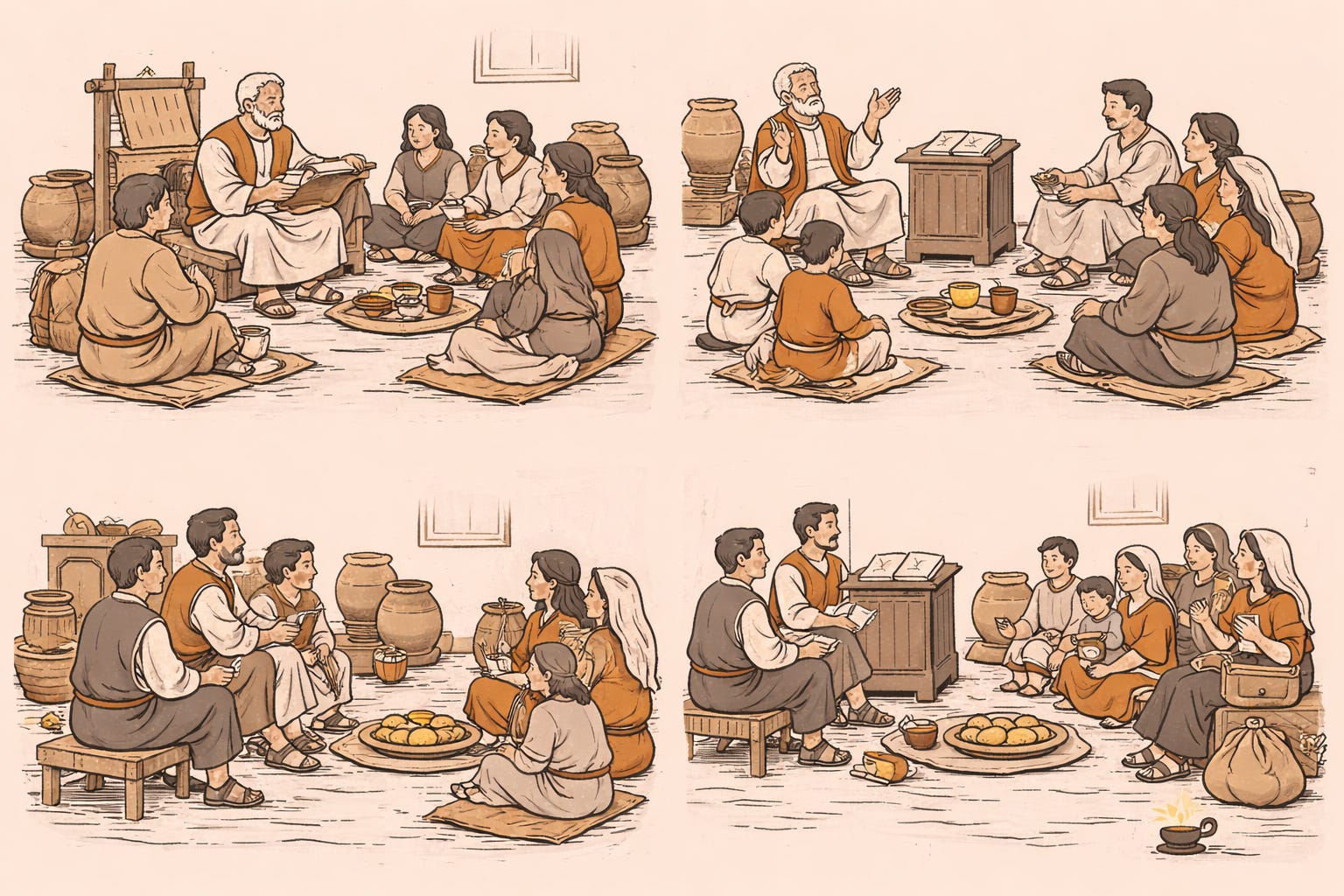
The New Testament consistently describes the church as a people joined to Christ — not a grand structure, institution, or corporate-like organization. In the first couple of centuries since the death and resurrection of Jesus Christ, there were no dedicated church buildings, no denominations, and no religious tax benefits.
The ‘Christian church’ was the people.
This group of witnesses and early believers had decided to put all their eggs in one basket. They had decided to see Jesus as the resurrected Messiah, the Alpha and the Omega — a Savior with authority to forgive sins. These initial followers of Jesus believed that the ancient Jewish prophecies had been fulfilled and were convinced He was the ‘chosen one.’
Those who were not Jewish — the Gentile followers of Jesus — had rejected a plethora of pagan gods, rituals, and traditions. In doing so, they renounced the impulse to worship themselves and their own ambitions and desires.
The early Christians understood that choosing to belong to this group of people would be an all-in, all-the-time, leave-everything-behind kind of commitment. To those who did not believe, this was a radically risky move. Jesus had been publicly, brutally crucified — and his disciples and the next generation of followers were being proactively persecuted, ridiculed, and put to death.
Writing about Nero’s response to the Great Fire of Rome in AD 64, the Roman historian Tacitus described how Christians in the city were singled out for awful punishment:
“…Nero fastened the guilt and inflicted the most exquisite tortures on a class hated for their abominations, called ‘Chrestians’ by the populace… Mockery of every sort was added to their deaths. Covered with the skins of beasts, they were torn by dogs and perished, or were nailed to crosses, or were doomed to the flames and burnt, to serve as a nightly illumination, when daylight had expired.”
— Tacitus, Annals 15.44 (historical account of Nero’s persecution of Christians after the Great Fire of Rome)
The early Christians lived in adoration of who Jesus was, his incarnation, and what He had fulfilled at the cross. Their faith, and hope was all in Christ.
While Paul referenced location when he called believers ‘the church of God that is in Corinth,’ he treated the church as the community of saints in a city.
“To the church of God which is in Corinth, to those who have been sanctified in Christ Jesus, saints by calling, with all who in every place call on the name of our Lord Jesus Christ, their Lord and ours.”
— 1 Corinthians 1:2
He referred to the church as ‘God’s building’ made of people, with Christ as the only foundation — not bricks and stone:
“For we are God’s fellow workers; you are God’s field, God’s building.”
— 1 Corinthians 3:9
Back then, there was nothing like what we now call ‘cultural Christianity.’ With little social benefit and real risk, it would have been rare to claim the name ‘Christian’ without serious commitment.
About a century later, an anonymous Christian wrote to a pagan named Diognetus, trying to describe what made this scattered community so different:
“Any country can be their homeland, but for them their homeland, wherever it may be, is a foreign country. They live in the flesh, but they are not governed by the desires of the flesh. They pass their days upon earth, but they are citizens of heaven. Obedient to the laws, they yet live on a level that transcends the law… Christians love all men, but all men persecute them. Condemned because they are not understood, they are put to death, but raised to life again. They live in poverty, but enrich many; they are totally destitute, but possess an abundance of everything.”
— Epistle to Diognetus 5-6 (second‑century Christian apologetic text)
Choosing to follow Jesus usually meant that your Jewish and Gentile friends and family would cut their ties from you. Christian community mattered deeply.
“For just as the body is one and yet has many parts, and all the parts of the body, though they are many, are one body, so also is Christ. 13 For by one Spirit we were all baptized into one body, whether Jews or Greeks, whether slaves or free, and we were all made to drink of one Spirit.”
— 1 Corinthians 12:12-13
In his 1st letter to the Corinthians, the Apostle Paul uses the analogy of the human body to explain the unity and diversity of the Christian church.
This ‘Body of Christ,’ emphasizes that while there are many different members and each believer comes with his or her own gifts — together — they form a single body. This means that each part is essential, interdependent, and honored by God, promoting harmony and mutual necessity.
In his letter to the Ephesians, Paul says God put all things under Christ’s feet — making Him the head over all things to the church.
“He put all things in subjection under His feet, and made Him head over all things to the church, which is His body, the fullness of Him who fills all in all.”
— Ephesians 1:22
The Christian church was, is, and will always be a people. It’s not a place or a thing or an entity, but a people — joined as a community, and as a body, by the God who made it all.
What a privilege and joy to be part of His church! That should make us pause, reflect, and repent. It should lead us to worship.
